We tend to associate the quality of our lives with big, life-altering moments or heroic efforts. I believe reality is much more subtle and tangible: our well-being and productivity are determined by the tiny, almost unnoticeable micro-decisions scattered throughout the day. We can view these moments as critical tipping points that determine whether we head towards a “win” or a “loss” on any given day.
A micro-decision is not just a choice; it is the moment when we consciously or subconsciously decide whether we are in control, or if we are going to let circumstances drag us along like a runaway horse. These tiny crossroads accumulate and ultimately determine our mental capacity, emotional stability, and physical energy. The first, and perhaps most defining, of these choices awaits us the moment we wake up, while we are still under the covers.
The First Choice: What Do You Touch First After Waking Up?
The strategic importance of the first 60 seconds after waking up is invaluable for the nervous system. This is the point where it’s decided whether we will live through our day as creators or merely as reactors.
The “Dopamine Lemon” Metaphor
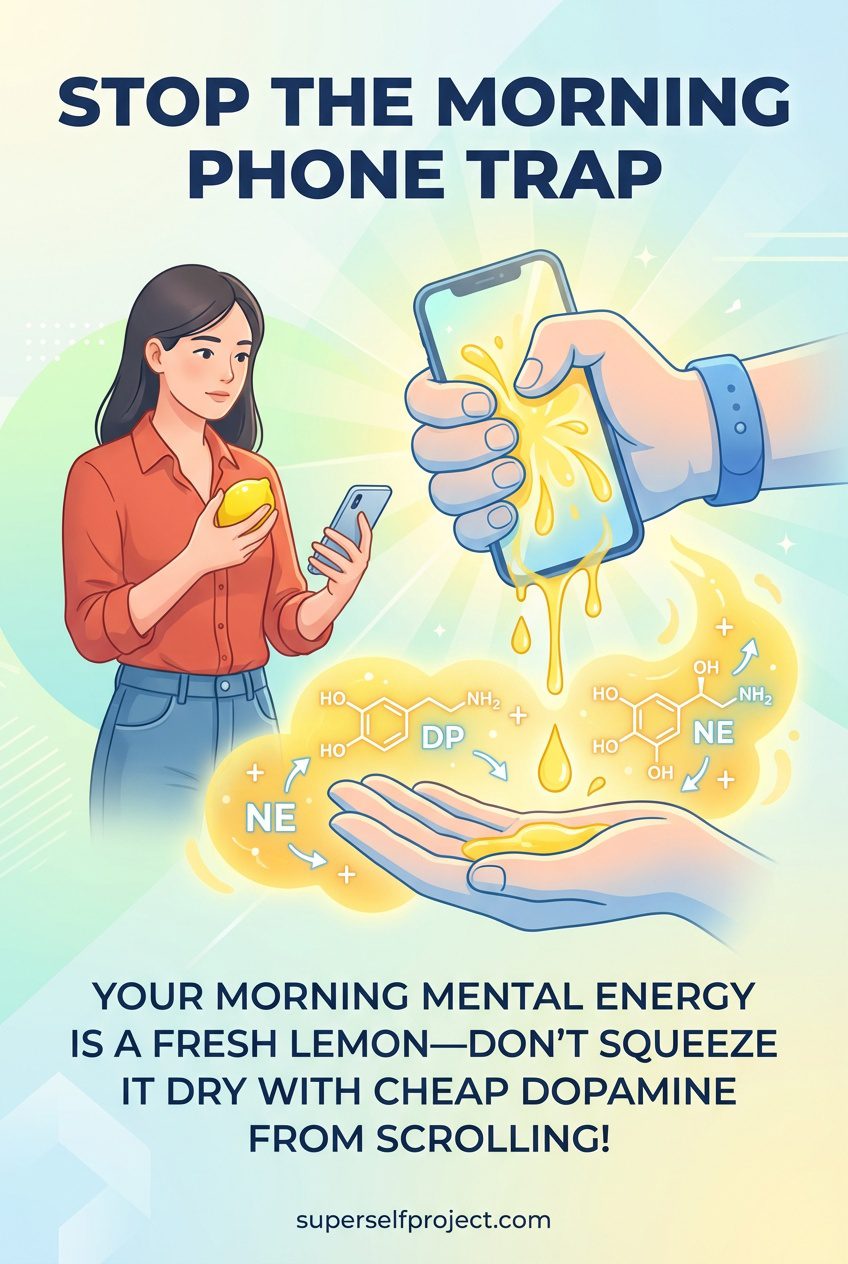
Research by Dr. K, a Harvard-trained psychiatrist, sheds light on the fragility of our dopamine system. Imagine our morning mental energy as a fresh, juicy lemon. Upon waking, this lemon is full of potential, ready to fuel our motivation and focus. However, when our very first move is reaching for our phone, it’s like putting a “hard squeeze” on that lemon.
Dr. K points out a critical difference: if we work for four hours in the morning, we feel satisfaction and reward at the end. But if we spend the first four hours (or even just the first thirty minutes) consuming technology—news, social media—it brutally “squeezes” the lemon so much that even if we were to do the same work later, we would be biologically incapable of feeling satisfaction or joy. Our dopamine stores are simply depleted by “cheap” stimuli.
The Consequences of Morning Phone Use:
- Surrendering Control: You don’t decide what you pay attention to; algorithms and news dictate it.
- Emotional Overload: The flood of tragedies, angry comments, and advertisements immediately triggers your stress response.
- Loss of Focus: By 6 AM, we are already conditioning our brains to constantly seek out new, brief stimuli instead of genuine deep work.
“So What?” – Why Does This Matter? Morning phone use isn’t just a waste of time; it’s a kind of “mental death sentence” for the day. By reaching for your phone, you voluntarily surrender your agency and capacity to act. This is why you feel irritable and unfocused in the afternoon: you’ve already squeezed your “lemon” dry while sitting in bed.
The Second Choice: Setting the Day's Internal Narrative
Most people think having a “good day” or a “bad day” is a matter of luck. Science, however, says it is an internal setting—the result of a mindset.
The Science of Mindset
Dr. Alia Crum, a researcher at Stanford University, has proven that our mindset is not just a thought, but a biological command that alters the body’s physiological responses. Mindset is a filter through which our brain processes reality.
Dr. Crum’s research encourages us to ask ourselves:
- “Is stress killing me, or is it actually making me stronger?”
- “Is healthy eating a form of deprivation, or a rewarding investment in my body?”
When, after a morning setback (like a wasted hour or running late), we say, “This is going to be a terrible day,” our brain receives a command to gather evidence. From then on, a traffic jam, a boss’s criticism, or a dropped object all become proof of a “bad day.”
“So What?” – Why Does This Matter? Consciously choosing a “good day” is not toxic positivity. It is a strategic tool. It doesn’t mean difficulties will disappear; it means you decide that you determine your internal state, not external circumstances. By declaring, “Today will be a good day because I am bringing good energy with me,” you armor your body against stress and empower yourself to focus on solutions instead of problems.
The Third Choice: Fuel or Fumes?
Many believe that skipping meals is a sign of “hustling” and efficiency, but this is the biggest mistake you can make.
The Role of Protein and Cortisol
Dr. Nicole LePera (the Holistic Psychologist) points out that in the first 30 minutes after waking, our cortisol (stress hormone) levels are naturally high. If we start with only caffeine at this time, it’s like pouring oil on a fire: we increase internal tension and emotional instability. Eating protein in the morning, however, stabilizes blood sugar levels, which directly aids emotional regulation.
The “Sandwich Cure”
Dr. Karl Pillemer (Cornell University) spent decades researching the wisdom of older generations for the “Legacy Project.” One of his most important pieces of advice on conflict resolution is: “If you get into a seemingly unresolvable argument, eat a sandwich first, and then see if there’s still anything left to argue about.”
Many relationship or workplace “dramas” are actually physiological, not psychological, in origin. Hunger (operating on “fumes”) turns us into monsters.
Practical Guide to Running on Fuel:
- Protein First: Consume at least 20-30 grams of protein before or alongside your coffee.
- Recognizing “Hanger”: If you are overwhelmed by anger, stop and ask: “When did I last eat?”
- Quality Stabilization: Avoid sugary breakfasts that cause a sudden energy spike followed by a crash.
“So What?” – Why Does This Matter? Proper nutrition radically changes our perspective. “Unsolvable” problems tame into manageable tasks when your brain isn’t fighting for survival due to hunger. Protein deficiency can literally sabotage your marriage or your career.
The Fourth Choice: Scrolling or Sleeping?
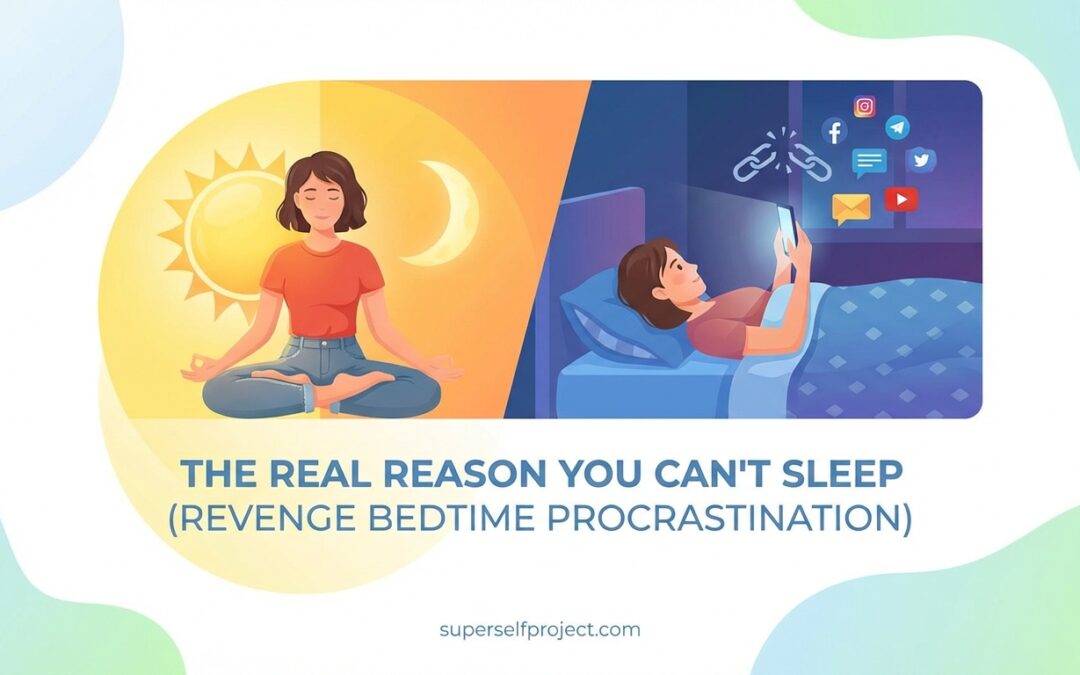
The final micro-decision of the day is actually the foundation of tomorrow’s success. Here we encounter the phenomenon of “revenge bedtime procrastination”: because we felt we lacked control over our time during the day, we try to “steal back” freedom from the night through aimless scrolling.
The Biological Barrier
Research by Dr. Anne-Marie Chang (Harvard) has shown that the blue light from screens suppresses melatonin and delays our internal biological clock. When you scroll in bed, your brain gets the message: “We’re taking off!”, while your body actually needs help “landing.”
Richard Bootzin (Northwestern University) emphasizes the importance of associative learning: your brain is a pattern-recognition machine. If you use your bed as an office, a movie theater, or a mall, your brain forgets to associate the bed with sleep. This is why you wake up in the middle of the night, and why you reach for your phone even then—because you’ve conditioned yourself to do so.
Evening Ritual Plan for Recovery:
- Phone “Curfew”: Put your phone in another room at least 30 minutes before sleep.
- The Sanctity of the Bedroom: The bed should be for sleep (and intimate moments) only.
- Substitute Ritual: Choose an analog activity: a hot bath with Epsom salts, reading, stretching, or laying out tomorrow’s clothes.
“So What?” – Why Does This Matter? Your evening choice determines not only the quality of your sleep but also your first micro-decision the next day. If you put your phone down on time, you’ll wake up rested and be much more likely to avoid the morning dopamine trap. This brings the cycle full circle.
Taking Back Control
In this chaotic world, there are few things we can fully control, but these four micro-decisions—what you reach for first, what mindset you choose, how you fuel yourself, and when you put away your devices—are in your hands. These tiny “switches” determine whether you live in an exhausting spiral or if you direct your own energy.
Remember: you don’t have to be perfect. If you mess up one decision, you can take back the steering wheel at the next one—whether at lunchtime or in the evening. Every single new decision is a new opportunity for change. Start small, and watch as these micro-movements bring radical improvement to every area of your life. Choose your next step as if your whole day (and future) depended on it—because, in reality, it does.