
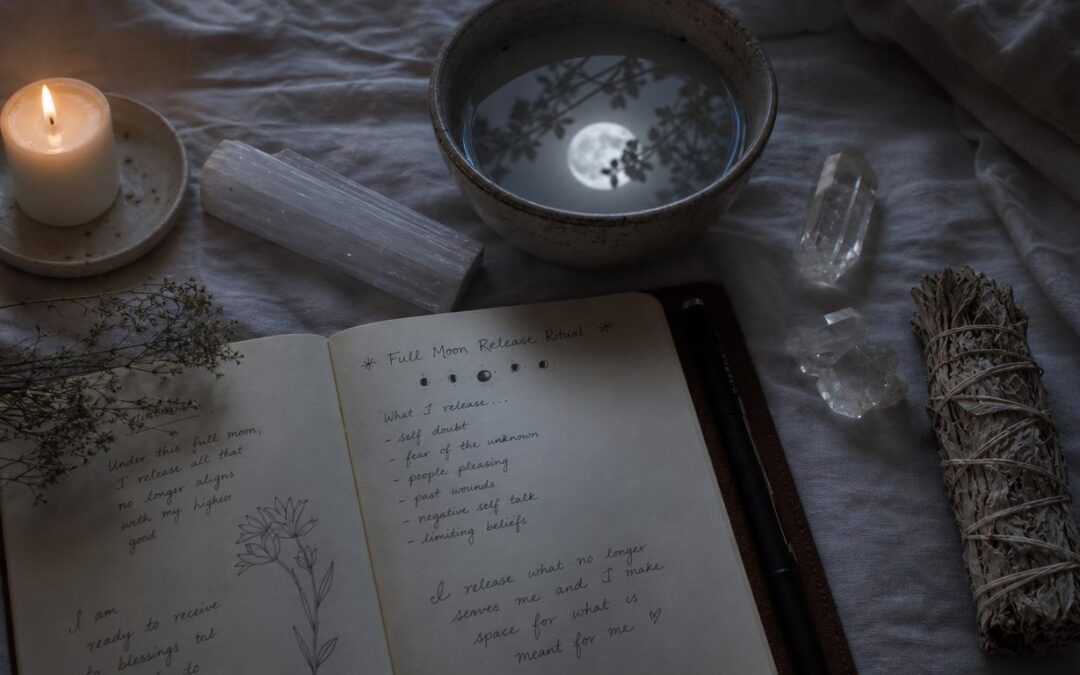
I did my first proper full moon ritual on a night when I was completely burnt out — overworked, resentful, and carrying a grudge I couldn’t seem to put down. I’d read about release rituals and felt a bit silly, but I lit a candle, wrote the whole mess out on a scrap of paper, and burned it over my kitchen sink. I won’t pretend the moon worked magic, but the act of naming what I was carrying and physically letting it go left me lighter than I’d felt in weeks. I’ve done a version of this most months since, and it’s become one of my steadiest self-care anchors.
You don’t need to be into astrology or own a single crystal to do this — I’m proof of that. A full moon release ritual is really just intentional self-care with a bit of ceremony around it: a pause to notice how far you’ve come, name what you’re ready to set down, and make room for what’s next. Here’s exactly how I run mine, including the journaling prompts I come back to and the steps you can adapt to fit you.
Why the Full Moon Suits Letting Go
In the lunar cycle, the full moon is the peak — the moon at its brightest and most complete. If the new moon is for planting seeds and setting intentions, the full moon is the opposite bookend: a moment for harvesting, acknowledging, and releasing what you’ve outgrown. I find that framing genuinely useful, because it gives my reflection a shape rather than just vague brooding.
What I’ve come to believe, after doing this for a few years, is that you don’t have to think the moon holds any mystical power for the ritual to do its work. The real shift happens in the pausing, the honesty, and the deliberate choice to let something go. The full moon is simply a reliable, recurring cue on the calendar that nudges me to actually sit down and do it — and that nudge turns out to be most of the value.
When I Do Mine
The full moon’s energy is strongest on the night it peaks, but I’ve never been precious about timing. I do my ritual the evening of the full moon or within a day or two on either side, and it feels just as meaningful. If you’d like to anchor yours to a specific lunation, you can simply check when the next full moon falls and plan for that night.
Honestly, the best time is whenever you can carve out 20 to 45 minutes of quiet without interruption. I learned early on that a perfectly timed ritual I’m too tired to actually do is worth far less than a slightly-off-schedule one I show up for. Pick a window when you can genuinely slow down and be with yourself.
Setting the Scene
Before I start, I spend a few minutes turning my space into something that feels calm, because it signals to my body that it’s time to slow down. None of this is fancy — it’s mostly about intention and a few comforting touches that work for me:
- Dim the lights and light a candle or two — I like a plain white one.
- Freshen the air — I crack a window or light a little incense and take a few slow breaths.
- Gather your tools: a journal and pen, a candle, and a fireproof dish or a bowl of water for the release.
- Add comfort: a soft blanket, a warm cup of herbal tea, quiet music, maybe a drop of lavender oil.
- Silence your phone. This is the one I have to be strict about — do-not-disturb, face down, out of reach.
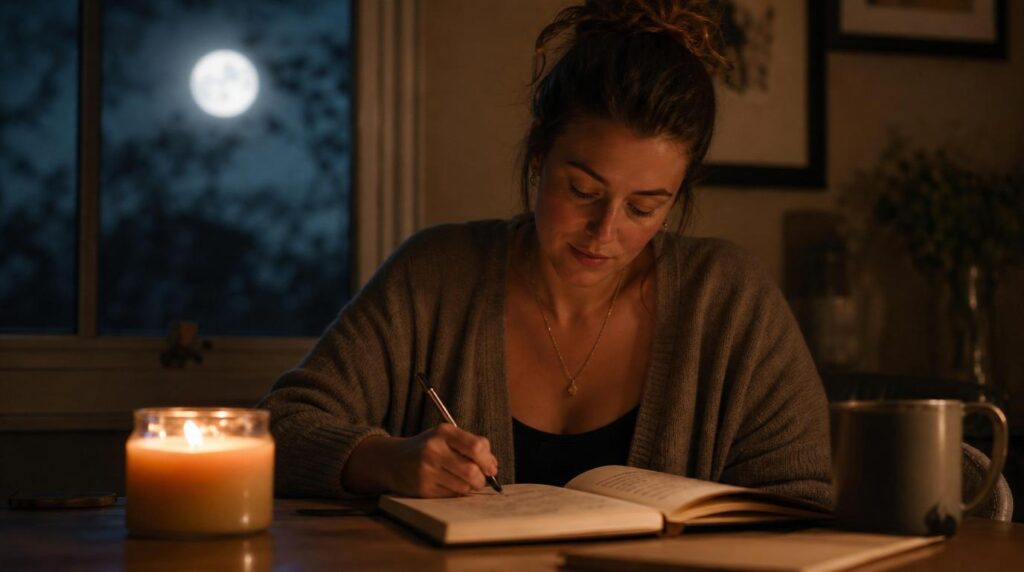
If you can sit where you can actually see the moon, that’s a lovely bonus — I do mine by the window when the sky’s clear. But it’s not required. The space that really matters here is the inner one you’re making room in.
My Full Moon Ritual, Step by Step
Here’s the sequence I follow. Move through it slowly and change anything that doesn’t fit you — there’s no wrong way to do this, and mine has shifted plenty over the years.
Step 1: Arrive and Ground Yourself
I settle in and take several slow breaths — in for four counts, hold for four, out for six — until my shoulders drop. I let my body feel fully supported by the chair or the floor, and I just arrive. When I feel settled, I put a hand on my heart and quietly tell myself, “I’m here, I’m safe, I’m ready to let go.” It sounds small, but it reliably shifts me out of my buzzing head and into the moment.
Step 2: Reflect and Acknowledge
I open my journal and spend a few minutes looking back over the past month — what happened, what I learned, where I grew. I make a point of celebrating the small wins, because I’m quick to skip past them, and I try to honor the hard parts without judging myself for them. I usually start by listing a few things I’m grateful for; it softens me and makes the harder reflection that follows feel safer.
Step 3: Name What You’re Ready to Release
Now I turn toward what’s ready to go. I use the prompts below to guide me, and I write freely and honestly — knowing no one else will ever read it is what lets me be truthful. Let it pour out:
- What beliefs or stories about myself am I ready to release?
- What habits or patterns are no longer serving my well-being?
- What emotions have I been holding that I’m ready to feel and let go of?
- What relationships or dynamics are draining my energy?
- What fear has been keeping me small?
- What am I ready to forgive, in myself or someone else?
- What would feel lighter to put down before the next chapter?
Step 4: The Release
On a separate piece of paper, I write down everything I’m ready to release, as clearly and specifically as I can. Then I read it over once and say, out loud or in my heart, “I release what no longer serves me. I let go with gratitude. I make space for peace.” Saying it aloud the first time felt awkward, but it’s the part that makes the whole thing land for me.
Then I safely destroy the paper — usually I burn it in a dish over the sink, but tearing it into tiny pieces or soaking it until the ink dissolves works just as well. As it goes, I picture the weight lifting off my shoulders and breathe all the way out. That exhale is where I actually feel the shift.
Step 5: Fill the Space With Care
Letting go leaves an opening, so I fill it with something nourishing rather than rushing back to my phone. This is the self-care heart of the whole thing. Depending on the night, I’ll run a warm bath, do a slow skincare routine, stretch gently, or just wrap up in my blanket with the tea I made earlier — and as I do, I imagine calm and clarity moving into the space I cleared.
Step 6: Close With Intention
To finish, I put both hands on my heart, take a few final breaths, and thank myself for showing up — which still feels slightly unfamiliar, and which I think is exactly why it matters. I set a gentle intention for how I want to feel in the coming days, usually a single word like “peaceful” or “open.” Then I blow out the candle and carry that quiet with me to bed.
More Journaling Prompts for Deeper Reflection
If journaling is the part you love most — it’s mine — here are more prompts I turn to on the night of the full moon or in the days after, when I want to sit with something longer:
- What am I most proud of myself for this month?
- Where have I been too hard on myself, and how can I offer more compassion?
- What is my body trying to tell me right now?
- What boundary do I need to set to protect my peace?
- If I fully let this burden go, who would I become?
- What does my heart actually need more of right now?
- What am I ready to welcome into the space I’ve cleared?
Smaller Ways to Honor the Full Moon
On the months when I don’t have the energy for the full ritual — and there are plenty — I still like to mark the full moon in some small way. If you’re short on time, any one of these is enough:
- Take a long bath with epsom salts and a few drops of essential oil.
- Leave a glass of water on the windowsill overnight and drink it slowly in the morning.
- Switch the screens off for the evening and give your mind a real rest.
- Stretch or do slow yoga to release the tension your body’s been storing.
- Declutter one small thing — a drawer, your bag — as a physical act of letting go.
- Step outside and just look at the moon for a minute, breathing in the night air.
- Go to bed early and let yourself have a genuinely restful night.
Making It a Monthly Habit
What I love most about this practice is that the full moon comes back around every month, roughly every 29 days, handing me a reliable reminder to pause and reset. Over time it’s become a rhythm I count on — a monthly check-in with myself that releases stress before it has a chance to pile up, and keeps me honest about how I’m actually doing.
I don’t do the whole ritual every single month, and I’ve stopped feeling guilty about that. Some months I journal by candlelight for an hour; other months I take a bath and whisper “I let go” and call it done. Both count. The point was never to do it perfectly — it’s the simple, repeated act of showing up for myself.
Set It Down and Begin Again
Life piles up — the stress, the worries, the old stories we keep telling ourselves. For me, the full moon ritual has become a monthly permission slip to set all of that down and start fresh. That first burnt-out night taught me how much lighter I feel when I stop carrying things out of pure habit, and I’ve gone back to that lesson again and again.
So next time the moon is full, try carving out a little time just for you. Reflect, release, and refill your own cup — and notice how much clearer you feel on the other side of it. If you want to work with the whole lunar cycle, pair this with a new moon intention-setting practice and let the two bookend your month.