
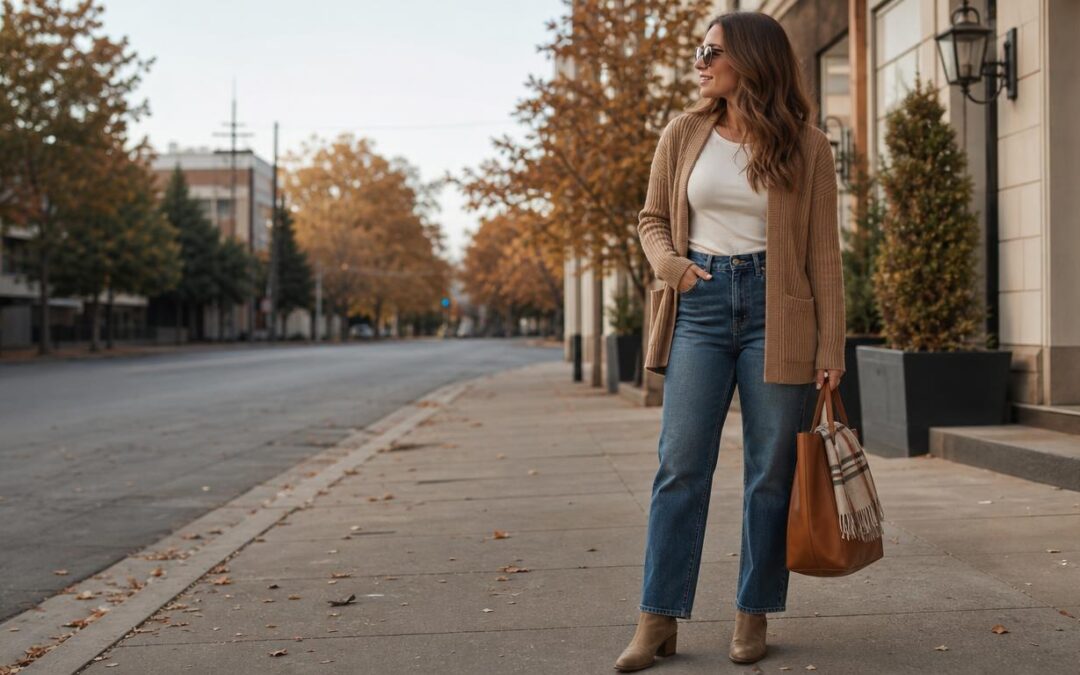
There’s a specific kind of fall morning that used to defeat me completely: 48 degrees when I leave the house, 68 by lunch, and a cold wind that makes a liar out of the sunshine. For years I’d either freeze all morning or roast all afternoon, hauling a jacket I didn’t want because I’d guessed wrong. The fall outfit ideas that finally solved this weren’t about buying more clothes — they were about learning to layer properly, so one outfit could handle a thirty-degree swing without me committing to being too hot or too cold. This is the transitional dressing formula I now use on repeat, built for that maddening in-between weather when it’s not quite summer and not yet winter.
Why layering is the whole game in transitional weather
The reason in-between weather is so hard to dress for is that you’re not dressing for one temperature — you’re dressing for three or four over the course of a day. A single heavy sweater traps you the moment the sun comes out; a single light top leaves you shivering at 8 a.m. The fix is to build outfits in removable layers, so you can peel off or add back a piece as the day shifts. It sounds obvious, but the difference between “wearing a jacket” and “layering with intention” is enormous once you understand the logic.
Good layering works in three roles: a base layer against the skin, a middle layer for insulation, and an outer layer for wind and weather. On a transitional day you might wear all three at 8 a.m. and be down to just the base by noon. The trick is choosing pieces where every combination looks deliberate — so you’re not just stripping down to a sad undershirt, but revealing a second complete outfit underneath. Once I started thinking this way, that thirty-degree swing stopped being a problem and became almost fun to dress for.
The base layer: where a good outfit quietly begins
I used to treat the base layer as an afterthought, something no one would see. Then I realized that on warm afternoons it’s the only thing anyone sees, so it has to look good on its own. Now I build every transitional outfit on a base layer I’d happily wear alone.
My workhorses are fitted long-sleeve tops in breathable fabrics — a fine ribbed cotton knit, a lightweight merino, or a smooth modal tee. The key is fitted, not tight: a slim base layer sits cleanly under a sweater without adding bulk, and if you shed the middle layer, it still looks intentional. Merino wool is my quiet hero here because it regulates temperature both ways, keeping you warm when it’s cool and wicking sweat when it warms up — genuinely the ideal fabric for a day that can’t make up its mind. I keep these in my palette neutrals so they play well with everything layered on top.
The middle layer: cozy, but easy to remove
The middle layer is the piece I add and subtract most, so it has to be genuinely easy to take off and carry without ruining the outfit or bulking up my bag. This is where I have the most fun, because it’s the cozy layer that reads as “fall” the second you put it on.
Cardigans over pullovers, for transitional days
For in-between weather specifically, I reach for a cardigan far more often than a pullover, and the reason is purely practical: a cardigan opens. When the afternoon warms up, I can unbutton it or take it off without wrestling a sweater over my head and wrecking my hair in the office bathroom. A chunky ribbed knit cardigan over a fitted tee is my single most-worn transitional combination, because it looks put-together buttoned up in the cold morning and casually great slung open or tied around my shoulders once it warms. When I do wear a pullover, I choose a lightweight one — a fine-gauge knit rather than a heavy cable — so I’m not stuck in a sauna the moment the sun appears.
The overshirt: the layer I didn’t know I needed
The other middle-layer piece that transformed my fall wardrobe is the overshirt, or “shacket” — that structured shirt-jacket hybrid in brushed cotton, flannel, or lightweight wool. It’s warmer than a shirt, lighter than a coat, and it hits the transitional sweet spot exactly. I wear it open over a tee for a relaxed look, or layered under a proper coat on the coldest mornings for extra insulation I can remove indoors. Its slight structure means it looks intentional even when everything under it is casual, which is why it’s become my grab-and-go layer for uncertain days.
The outer layer: only when you actually need it
On true in-between days I often skip a heavy coat entirely and let the middle layer do the work, adding an outer layer only for wind or an early-morning chill. When I do want one, I choose light and unlined over heavy and insulated, because the goal is a windbreak, not a winter fortress.
A classic trench coat is the transitional outerwear piece for a reason — it blocks wind and light rain, layers over a cardigan without crushing it, and looks polished with everything. A denim or utility jacket does the casual version of the same job. The mistake I made for years was jumping straight to my warm winter coat the first cold week, then sweating by afternoon; a lighter unlined jacket bridges the gap far better and stops the outfit from looking like it belongs to a colder month than the calendar says.
Putting it together: a week of transitional outfits
To make this concrete, here’s how the formula actually plays out across a few real days, so you can see how the same handful of pieces recombine.
For a casual errand day, I’ll pair a fitted merino tee, an open ribbed cardigan, and straight-leg jeans, with ankle boots and a crossbody bag. When it warms up, the cardigan comes off and the base looks complete on its own. For a slightly dressed-up day, I layer a silky camisole under a fine-knit pullover with tailored trousers, adding a trench if the wind picks up — three cozy, elegant layers that peel back into one clean outfit. And for a weekend of unpredictable weather, I’ll go with a long-sleeve tee, an overshirt, and wide-leg trousers or a midi skirt with tights, so I’m warm walking out and comfortable by noon. Notice how few actual pieces are in rotation — a couple of base tops, two or three middle layers, one light coat. Transitional dressing is less about volume and more about pieces that combine well.
A note on tights, socks, and the details that matter
The small stuff makes or breaks transitional comfort. A pair of opaque tights under a skirt or dress extends the season by weeks and adds a warm layer you can’t get from bare legs. Thicker socks that peek above ankle boots add both warmth and a little visual texture. And a scarf is the most useful transitional accessory there is — it warms you on the cold morning walk, then folds away into your bag the instant you don’t need it. These details are how you fine-tune an outfit to a specific day without overhauling the whole thing.
The outfit I reach for when I can’t decide
If the whole idea of layering still feels like a lot, here’s the single formula I fall back on when my brain is too tired to plan: a fitted base top, an open cardigan or overshirt, well-fitting jeans or trousers, and ankle boots, with a scarf stuffed in my bag as insurance. That combination handles almost any in-between day, looks pulled-together at every temperature, and requires zero morning math. Build a small rotation of base layers, a few easy-to-remove middle layers, and one light coat in colors that all coordinate, and the most frustrating weather of the year quietly becomes the easiest to dress for.