
Every year the summer solstice catches me off guard with how much it makes me want to stop. On June 21, 2026, the Sun reaches its highest point in the sky, giving us the longest day of the year — and at that very same moment, it slips into the tender, nurturing sign of Cancer. Light and feeling, radiance and softness, arriving hand in hand. If you’ve been craving a moment to breathe, take stock, and reset your intentions for the second half of the year, this is the day I’d build it around.
In this guide I’ll walk through what the solstice actually means, why this turning point has been marked for thousands of years, and — my favorite part — the rituals I genuinely use, whether I’ve got ten minutes or a whole golden afternoon. We’ll also touch on Litha, the old festival of midsummer, and how to welcome Cancer season with an open heart.
What Is the Summer Solstice? (And Why June 21, 2026 Is Special)
Astronomically, the solstice is the moment the Sun reaches its northernmost point relative to Earth’s equator. In 2026, that happens on June 21 at 4:24 a.m. EDT (9:24 a.m. BST for my UK readers). From then on, the days slowly begin to shorten again — which is exactly why so many ancient cultures treated this day with reverence. It’s the peak: the fullest expression of light before the gentle turn inward begins.
The word “solstice” comes from the Latin solstitium — “sun standing still.” For a few days around the solstice, the Sun appears to rise and set in nearly the same place, as if the sky itself is holding its breath. I love that image, and I try to take it as a personal cue: if the cosmos can pause at its busiest, so can I.
Astrologically, the solstice always coincides with the Sun’s move into Cancer — the cardinal water sign ruled by the Moon. So June 21, 2026 is a double doorway: the height of solar power and the start of a season devoted to home, feelings, intuition, and the people we love most. After the busy, mental energy of Gemini season, Cancer asks a softer question: how do you actually want to feel?
The Spiritual Meaning of the Solstice
Across nearly every culture, midsummer has carried the same core themes:
- Culmination and celebration — honoring how far you’ve come since the year began, even the messy parts. Especially the messy parts.
- Abundance and gratitude — the Earth is at her most generous right now: long evenings, ripening fruit, gardens in full bloom.
- Illumination — what the light touches, we can finally see. It’s a good time for honest self-reflection.
- The turning point — from here, the light wanes. There’s a bittersweet wisdom in that: everything peaks, everything cycles, and that’s what makes each season precious.
Litha: The Ancient Roots of Midsummer
If you’ve spent any time in spiritual corners of the internet, you’ve probably seen the word Litha — the name for the midsummer festival on the Wheel of the Year, the seasonal calendar followed in many pagan and earth-based traditions. Litha rituals traditionally centered on fire (echoing the Sun’s power), water (for blessing and healing), and herbs gathered at their peak potency.
The old celebrations were wonderfully dramatic: huge bonfires on hilltops, flaming sunwheels rolled into rivers, doorways crowned with St. John’s Wort and oak leaves, and all-night vigils to watch the midsummer sunrise. Stonehenge famously aligns with the solstice sunrise, and people still gather there every June to watch the first light crest the Heel Stone.
You don’t need a hilltop bonfire to tap into this lineage (though if you have a fire pit, I fully support the theatrics). The essence of Litha is simple: honor the light, outside you and inside you.
Summer Solstice Rituals for 2026: Choose Your Own
Here’s where it gets enjoyable. Below is a menu of practices — pick one, pick three, or build yourself an entire golden day. There’s no wrong way to do this. The most powerful ritual is simply the one you’ll actually do, with a bit of presence and intention.
1. Watch the Sunrise (or Sunset) With Full Presence
The simplest ritual of all, and honestly maybe the most profound. On June 21, set an early alarm, make a warm drink, and watch the sun rise on the longest day of the year. No phone, no multitasking — just you and the light.
As the sun climbs, silently name three things that have grown in your life since January, and let yourself actually feel proud of them. If mornings aren’t your thing (no judgment, night owl), the solstice sunset works just as well — it’s the latest sunset of the year, a slow golden goodbye that practically begs for reflection.
2. Create a Solstice Altar of Light
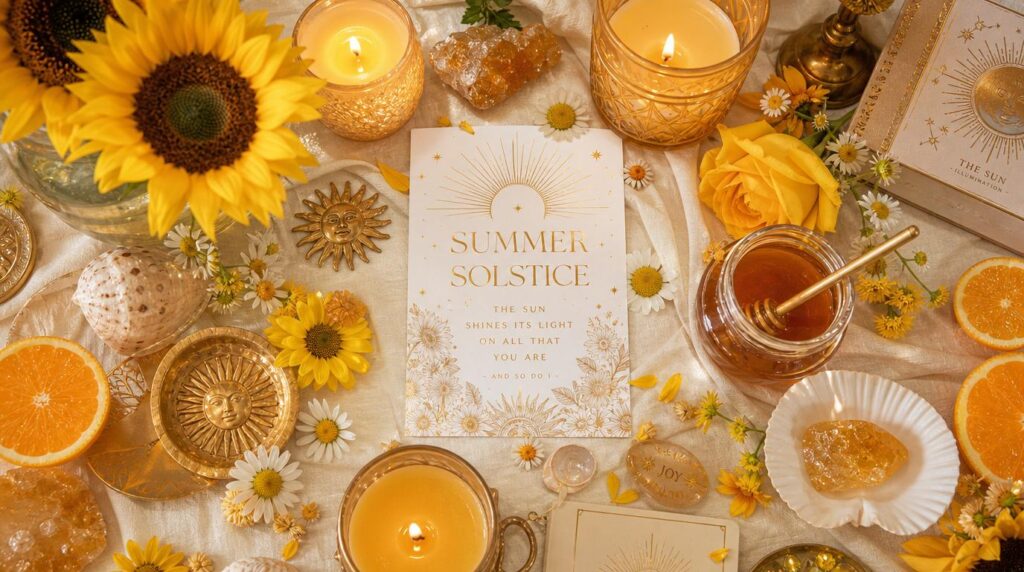
Gather objects that feel sunny and alive: yellow or gold candles, citrus fruit, sunflowers or daisies, citrine or carnelian, honey, seashells (a nod to incoming Cancer season), and anything that symbolizes what’s blooming in your life. Arrange them somewhere you’ll see daily.
Light the candle and speak — out loud, if you can — one sentence of gratitude and one intention for the second half of 2026. Mine last year was something like, “I’m grateful for the courage I found this spring; in the months ahead, I welcome deeper rest and softer self-talk.” Your altar can stay up through midsummer week as a small shrine to your own becoming.
3. The Mid-Year Review Journal Ritual
The solstice marks the halfway point of the calendar year, which makes it a natural moment for a loving check-in. Pour something cold and lovely, find a sunny spot, and journal on these prompts:
- What has been my greatest source of light since the year began?
- Which intention from January still matters to me — and which am I ready to release without guilt?
- Where in my life am I being asked to shine more brightly?
- What does “abundance” actually look like for me right now — not online, in my real life?
- As the light begins to wane, what do I want to ripen by autumn?
Don’t rush this one. Some of my biggest mid-year course corrections have come from twenty quiet minutes with these exact questions.
4. Fire Ritual: Release and Ignite
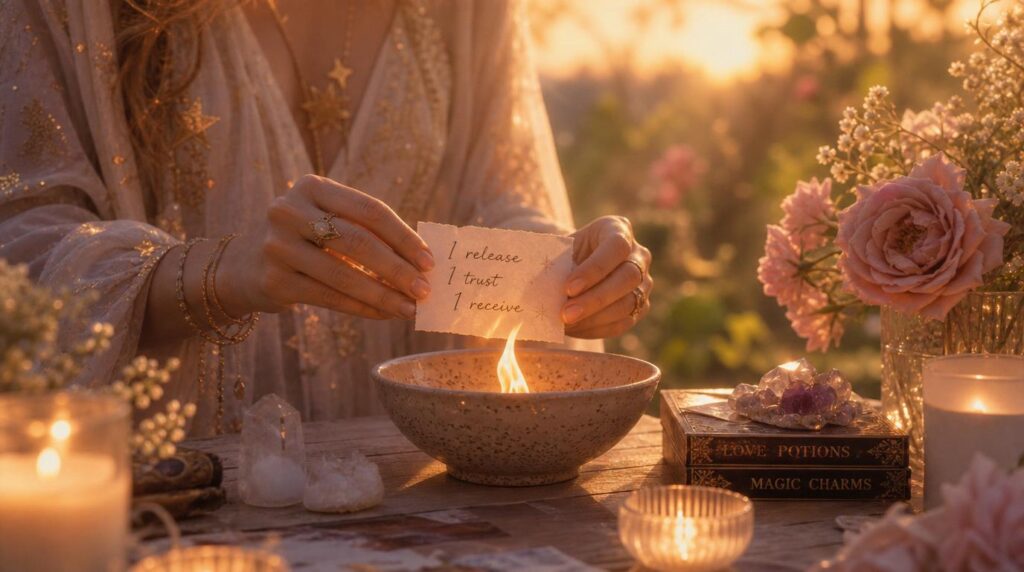
Fire is the heart of every traditional Litha celebration. Here’s a safe, flat-friendly version: write down one fear, habit, or story about yourself you’re ready to release — something that’s been dimming your light. Read it once, thank it for whatever it was trying to protect you from, then burn it safely in a fireproof bowl (or tear it into tiny pieces if open flame isn’t an option).
Then, on a fresh piece of paper, write what you’re igniting in its place. Keep that one. Tuck it into your wallet, your journal, or under a candle on your altar.
5. Solar Water and Sun Tea
A gentle, old-fashioned practice: fill a glass jar with clean water and set it in direct sunlight for a few hours on solstice day. Add fresh mint, lemon slices, or chamomile and you’ve made sun tea — delicious and symbolic. As you sip it, imagine yourself drinking in the year’s peak light: warmth, clarity, and vitality filling you from the inside.
6. A Barefoot Gratitude Walk
Cancer season loves anything that grounds you in your body and senses. Take a slow walk — barefoot on grass or sand if you possibly can — and devote it entirely to noticing: the warmth on your skin, the saturated green of midsummer leaves, birdsong, the smell of warm earth. Every few steps, name something you’re grateful for. It’s moving meditation at its most accessible, and it costs absolutely nothing.
7. Flower Crown or Herb Bundle Making
Channel your inner midsummer goddess. Gather seasonal flowers and herbs — traditionally St. John’s Wort, lavender, chamomile, rosemary, and yarrow, picked at midsummer when their potency peaks — and weave a simple crown, or tie a small bundle to hang by your door for protection and blessing, the way our great-great-grandmothers might have. Imperfection is part of the charm; wonky flower crowns have more personality anyway.
Welcoming Cancer Season: From Outer Light to Inner Glow
Here’s the lovely paradox of the solstice: at the exact moment of maximum external light, the zodiac shifts into its most internal, emotional sign. The Sun enters Cancer, and the mood softens from Gemini’s social sparkle to something quieter — home-loving, intuitive, deeply feeling.
Cancer is ruled by the Moon, and like the Moon, this season asks us to honor our phases. From June 21 to July 22, the themes likely to turn up in your life include:
- Home and sanctuary — a sudden urge to nest, redecorate, declutter, or simply spend more evenings in your own cozy corner.
- Family and chosen family — deepening bonds, healing old family patterns, or redefining what “home” means to you.
- Emotional honesty — feelings get louder in Cancer season. That’s not a malfunction; it’s information.
- Nourishment — literal (cooking, comfort food made healthy, hydration) and emotional (rest, boundaries, asking for support).
- Intuition — your inner voice gets clearer. Cancer season rewards those who listen to their gut.
One more thing worth a note in your calendar: just two days before the solstice, on June 19, 2026, Chiron — the “wounded healer” — enters Taurus for the first time in roughly fifty years, beginning a long chapter of collective healing around self-worth, money, and our relationship with our bodies. The solstice arrives right as this tender new story opens, which makes 2026’s midsummer feel especially significant. (I’ve written a whole separate guide to Chiron in Taurus if you want to go deeper.)
A Mini Ritual to Welcome Cancer Season
On solstice evening, run a bath or simply fill a bowl with warm water and a pinch of sea salt. Water is Cancer’s element, and this tiny ceremony bridges the fire of the solstice with the water of the season ahead. As you soak your body (or just your hands), say: “I welcome a season of feeling, nourishing, and coming home to myself.” Then moisturize like you mean it, put on something soft, and have an early, gorgeous night. Cancer season has officially begun, and you’ve greeted it on purpose.
Solstice Self-Care: Honoring Your Own Light
Rituals are wonderful, but the deepest solstice practice might simply be treating yourself like someone worth celebrating. The Sun doesn’t apologize for shining, and midsummer is my annual reminder that I don’t have to either.
A few gentle ideas for the day: wear something that makes you feel radiant, even if you’re not leaving the house. Eat dinner outside if the weather allows, and let it stretch long and lazy into the lightest evening of the year. Call someone who feels like sunshine. Write yourself a short letter to be opened at the winter solstice in December — a little time capsule of who you are at the year’s brightest point.
And if life is heavy right now? The solstice holds space for that too. The light touches everything — including grief, exhaustion, and uncertainty — and it doesn’t demand you perform happiness. Some years my most honest ritual has been sitting in the sun for ten minutes and letting myself be warmed, nothing more. That counts. You count.
Your Solstice Day, Beautifully Simple
If planning a whole ritual feels like too much, here’s an effortless solstice in three steps: greet the sun in the morning (even from a window), write down one gratitude and one intention at midday, and watch the sunset with someone you love — or in sweet solitude — in the evening. Light witnessed, light honored, light carried forward. That’s the entire assignment.
The solstice is more than an astronomical event — it’s a yearly meeting with your own radiance. However you choose to mark it, do it knowing that the same force that holds the Sun in the sky is alive in you too. Welcome the light, welcome Cancer season, and welcome the softer, more luminous second half of your year.
How are you marking the solstice this year? If you’d like the gentler, hour-by-hour version of the day, my summer solstice self-care guide is the perfect companion to this one.